Tag: The Gator

  • Area Woman’s Daughter Is A Triceratops (Yes, Really)

    Area Woman’s Daughter Is A Triceratops (Yes, Really)

    tritopskid3web

    By Chase Chapley

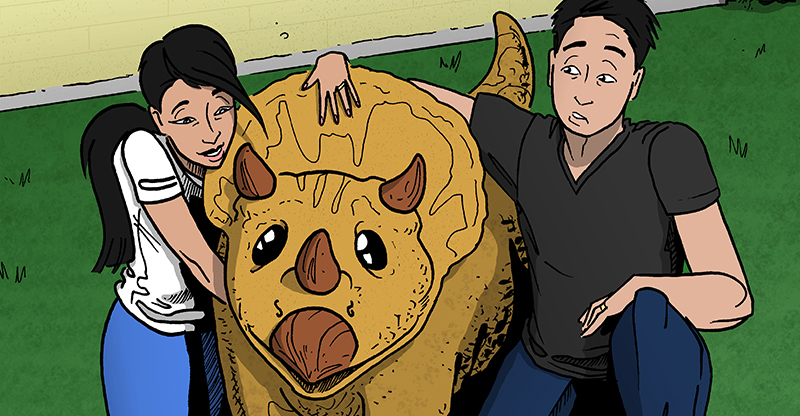
    Susan Wong thought she had lost her daughter during the Dino-Day Disaster.  She was nine-months pregnant at the time when she was transformed into a Triceratops, and like most of the city, she was confused and anxious, and her hormones didn’t help either.  Then she gave birth.  To an egg.

    “I was so excited to be a mother and was actually due in a week,” said Wong.  “My husband and I have been anxiously awaiting the birth of our daughter, and then I laid an egg.  I freaked out.”

    Wong was by herself at the time in Legends Park, and when she was beginning to have labor pains, she found a secluded spot in some bushes.  There, she laid her egg.  Exhausted and “freaked out,” she didn’t have time to contemplate or protect her egg.  The Dino Army was on its way to the park.  She had to run.

    “It was the hardest thing for me to do,” she said, “and I still feel terrible for abandoning my child.  But I tried to hide her as best I could and hoped the Dino Army wouldn’t find her.  I couldn’t carry her with me.”

    When she turned back to human, Wong went back to the park to look for her daughter.  She found egg shells, and the ground was wet.  There was no sign of a child, no tracks, nothing.  Her and her husband searched everywhere and contacted the police for help, but in the aftermath of the DDD, the authorities were stretched thin.  A few officers helped them search, but they found nothing.  “I thought I lost my baby,” she said, failing to hold back tears.

    Fast forward to last week, one of Professor “The Gator” Alan Guinness’s students was walking along the Winston River, and she came across a small Triceratops eating grass.  The Triceratops was about the size of a St. Bernard and was scared upon meeting the undergrad, Kiki Nagasaki.  “The little thing was so cute but also so shy,” she said.  “I grabbed a branch from a tree and inched closer to her.  I held out the branch, hoping she’d eat the leaves and let me get close to her.  And she did.  I petted her, and she just seemed so happy.  Then she tried to cuddle with me with her horns, which really hurt.”

    With the help of some friends, Nagasaki was able to transport the Triceratops to Professor Guinness’s lab, and the good doctor performed some tests.  The results from the DNA scan showed the Triceratops was human in origin, but her DNA was mutated.  Given his personal history with mutation, Guinness released the news to the press.  “I figured someone out there was missing a child,” he said.

    When Susan Wong heard the news, her and her husband rushed to Professor Guinness’s lab.  She knew it was her daughter.  Crying, she ran to her daughter and embraced her.  The Triceratops, perhaps recognizing her mother’s scent, became excited, hopping up and down and poking her mother with her horns (which were covered with blunt rubber tops by now).  The family was reunited.

    The father, Ken, was more befuddled than ecstatic.  While happy that his daughter survived the DDD, he wanted to know why she didn’t change back to a human like everyone else.  “Our working theory,” said Professor Guinness, “is that being transformed in the womb made the transformation permanent.  We’re not really sure why this is the case, but something in the magic the Dinosaur Queen used mixed with the Wongs’ specific genetics must’ve made this stick.”

    Guinness is still studying Lucy, the name the Wongs gave their daughter, and has offered to let her live at his office.  He promised the Wongs he would find a way to change their daughter back to human.  “After all,” he said, “she’s going to get very big.  Triceratops get to be as big as elephants, and being a 12-foot tall alligator man myself, my lab is big enough for Lucy.”

    But the Wongs insisted their daughter live with them for now.  “We’ll probably have to take the doctor up on his offer eventually,” said Susan.  “But for now, I want to spend every day with my daughter.  I’m just so blessed to have her in my life.”

    Ken seemed less enthusiastic.  “I love my daughter, of course,” he said.  “I just wish she didn’t eat so much and poke her horns into me.”

  • Ask Julia:  What About ‘The Gator’?

    Ask Julia: What About ‘The Gator’?

    askjulia

    By Julia Crumpleman

    profgatorWith New Romford still recuperating from the Dino-Day Disaster, I debated when I’d return to doing this column.  After all, there are much more pressing things to do, but that hasn’t stopped readers from sending me questions.  For any questions regarding the clean-up and recovery effort, please contact your local authorities and crisis management office.  They will be able to help you.

    Then it occurred to me that if I could provide some light distraction from our recent plight, why not do it?  So I picked one of the lighter questions and got a surprisingly pleasant response.  This question comes from Aaron in Carterson:

    Hey Julia, I was wondering what happened to Professor Gator at NRU?  Did he change into a dinosaur too?

    Aaron, I’m glad you asked because I hadn’t thought of it until now!  Furthermore, I wonder what happened to our extraterrestrial citizens.  They aren’t from Earth and would have no connection to dinosaurs.  Perhaps we’ll find out in time, but for now, I got the pleasure to speak with Professor Alan Guinness, a.k.a. “The Gator” or “Professor Gator”, about his experience.  Here’s what he had to say:

    Oh, ho ho, no I didn’t turn into a dinosaur, at least not what most people would think of when you say dinosaur.  I actually turned into an ancient version of an alligator.  From the best I could tell, I turned into a Deinosuchus riograndensis, basically a giant old alligator from the Cretaceous period.  I tripled in size, so I was about 30-35 feet long, and I wasn’t able to walk on two legs.

    It was a unique experience to say the least.  I was in my lab, which, thankfully, can hold a 30-foot long creature without much damage.  I was able to crawl out the door to see what was happening, but I really wasn’t able to do much other than destroy things with my tail by accident.  It was such a cumbersome thing.

    Thankfully, not much happened at my part of the campus.  The Dino Army wasn’t interested in us, apparently, so some of the professors and I kept the students together and took time studying ourselves.  I mean, how often do you get to study living, breathing dinosaurs up close and literally in person?  Once we got some food in us, we had a grand old time.  We gathered so much information on how dinosaurs walk, eat, and live.  I only wish we had hands so we could’ve written it all down, but we did the best we could.

    There you have it, Aaron!  I’m glad that someone was able to find something positive about the DDD, and Professor Guinness is just the alligator to do it.

  • Alligator Skin Outbreak in the Heights

    Alligator Skin Outbreak in the Heights

    By Muffy Borgeron

    profgatorAn outbreak of alligator skin has spread throughout the Heights in the past week, and residents are advised to get vaccinated.

    Alligator skin was a relatively benign disease that sprang up in the 70’s when New Romford University professor, Alan Guinness, was attempting to regenerate body parts in humans using reptilian DNA.  His experiments backfired when he was turned into an anthropomorphic alligator.  Initially, he ravaged NRU campus before being stopped by the Tarantula-Man and Dr. Amazing.  Dubbed “The Gator,” Guinness was able to regain control of his feral instincts but not his human form.  But his rampage spread the disease alligator skin, which slowly transforms a human’s skin into rough alligator-type skin but doesn’t transform them into rampaging lizard monsters.

    “I thought I had eradicated this disease years ago,” said Professor Alan Guinness, who still teaches biology at NRU.  “Dr. Amazing and I created a vaccine for it, and it was seemingly gone by the 90’s.  It became just another vaccine for children to get along with measles, mumps, and dragon pox.  But then people thought they contributed to autism, and now look where we are.

    “Turning into an alligator is what you get for not vaccinating your children.”

    Indeed, most of the cases have been reported in children under the age of twelve.  Health officials are trying to treat the disease as best they can but say that the best defense is prevention.  Guinness and his students have been creating new batches of the vaccine non-stop all week.